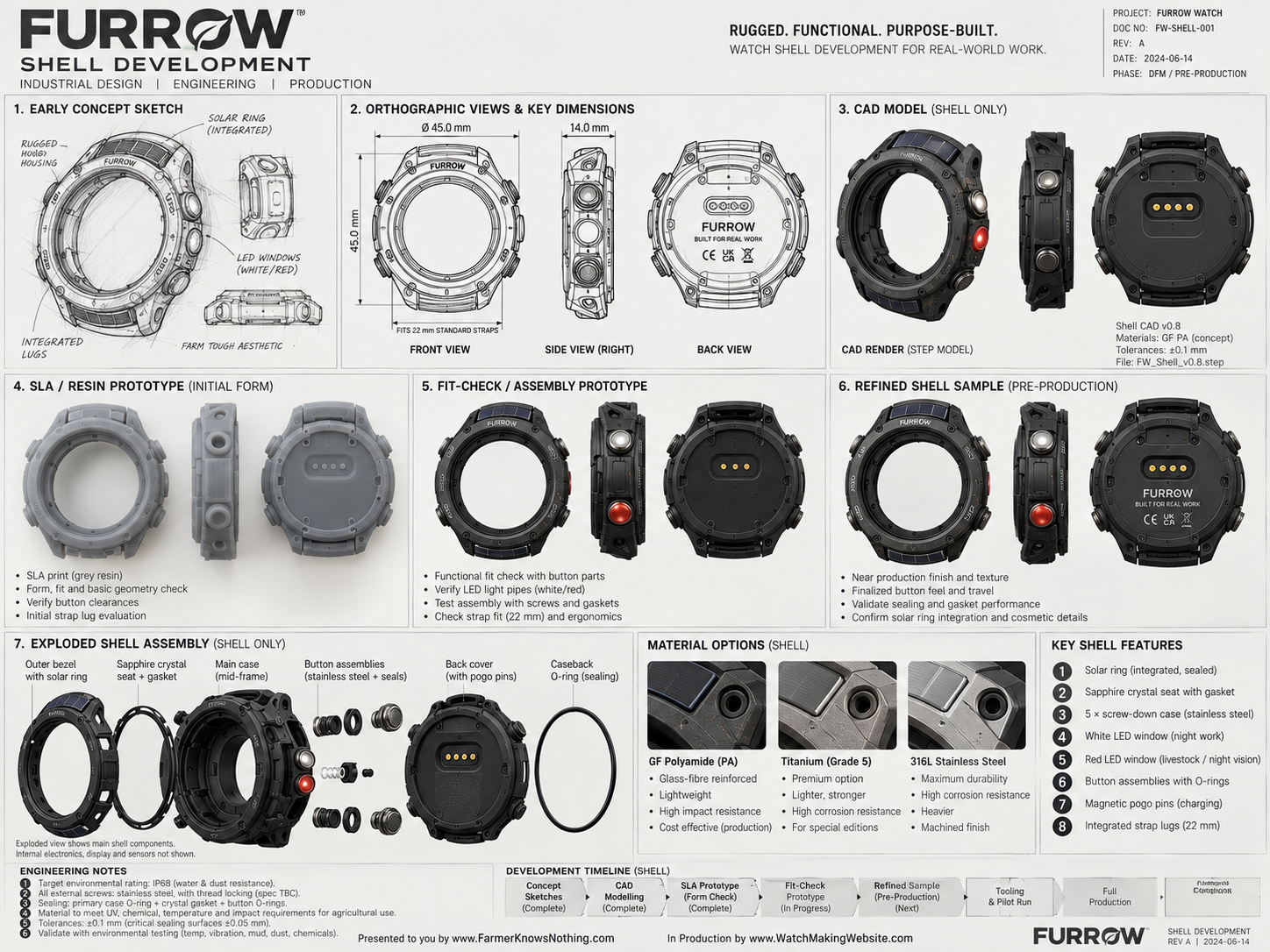
We added another company along side "The Balance Wheel Ltd" named "FarmerKnowsNothing" ( FarmerKnowsNothing and what we have put into beta stages and deep research on it so far with in depth conversation and planning without spending anything this is a small part of the research.
The design philosophy
A farmer's watch has different needs from a fitness watch. It gets hit on gates, covered in diesel, manure and fertiliser, used with gloves on, read in harsh sun, and worn in places with no phone signal. It also needs to run for weeks without a charger. So Furrow is built around five rules. It works fully offline. It lasts weeks, with solar top-up. It uses physical buttons first, because touchscreens fail with wet or gloved hands. It resists chemicals as well as water. And it's affordable enough for a smallholder in Kenya as well as a large arable farm in Lincolnshire, which is why it comes in tiers.
What it does on the wrist
Weather and field conditions. A barometer tracks pressure trends and gives storm warnings a few hours ahead. A lightning detector senses strikes up to about 40 km away and estimates distance, which is a real safety feature for anyone on a tractor or in an open field. There's a UV index sensor, and frost alerts come from small field sensor "pucks" (described below). A spray window screen combines temperature, humidity and wind from a puck to calculate Delta T. That's the agronomy measure for whether it's a good time to spray, and it shows as a simple green/amber/red light. Growing degree days are logged automatically for crop timing.
Location and mapping. Multi-constellation GPS lets you walk a field boundary and get the area in hectares or acres. You can drop pins with one button, for example "broken fence," "sick ewe," or "blocked drain," and add a voice note. A breadcrumb trail gets you back in fog or at night, and there's a compass and altimeter.
Lone-worker safety. Farming is one of the most dangerous jobs worldwide. Furrow uses its motion sensors to detect falls and "man-down" situations, such as no movement after an impact, which could mean a tractor rollover or a kick from a cow. It then escalates in stages: it vibrates first, then sounds a loud alarm, then sends an alert. The alert goes through the phone, through the farm's LoRa radio network, or, on the top tier, directly by satellite.
Farm radio network (LoRa). This is the creative core. LoRa is a long-range, low-power radio that reaches several kilometres in open country. The watch talks to cheap sensor pucks placed around the farm: soil moisture, water trough level, gate open/closed, frost, grain bin temperature. It can also send short text messages to other workers' watches with no phone signal at all, using a mesh network. That makes it compatible with the open-source Meshtastic system, so it can relay messages between devices.
Health and exposure. A heat-stress warning uses temperature, humidity and optional heart rate to prompt water and shade breaks. A noise dosimeter uses the microphone to track tractor, chainsaw or grain-dryer noise and warns when hearing protection is needed. A vibration exposure tracker uses the accelerometer to log hand-arm vibration time from chainsaws and strimmers, which relates directly to UK HSE vibration limits.
Records and timers. Timers cover spray re-entry intervals and pre-harvest intervals. One button logs a treatment, feed or medicine, and the record syncs later to build the paperwork. There are also milking and feeding reminders, a lambing and calving log, and sunrise, sunset and moon phase.
Practical extras. A white LED torch sits on the case edge, along with a red LED for night lambing and calving that doesn't ruin your night vision. A loud piezo buzzer can be heard over machinery, and a strong vibration motor handles the times you can't hear anything. The interface is icon-first and multi-language so it works for any literacy level or country.
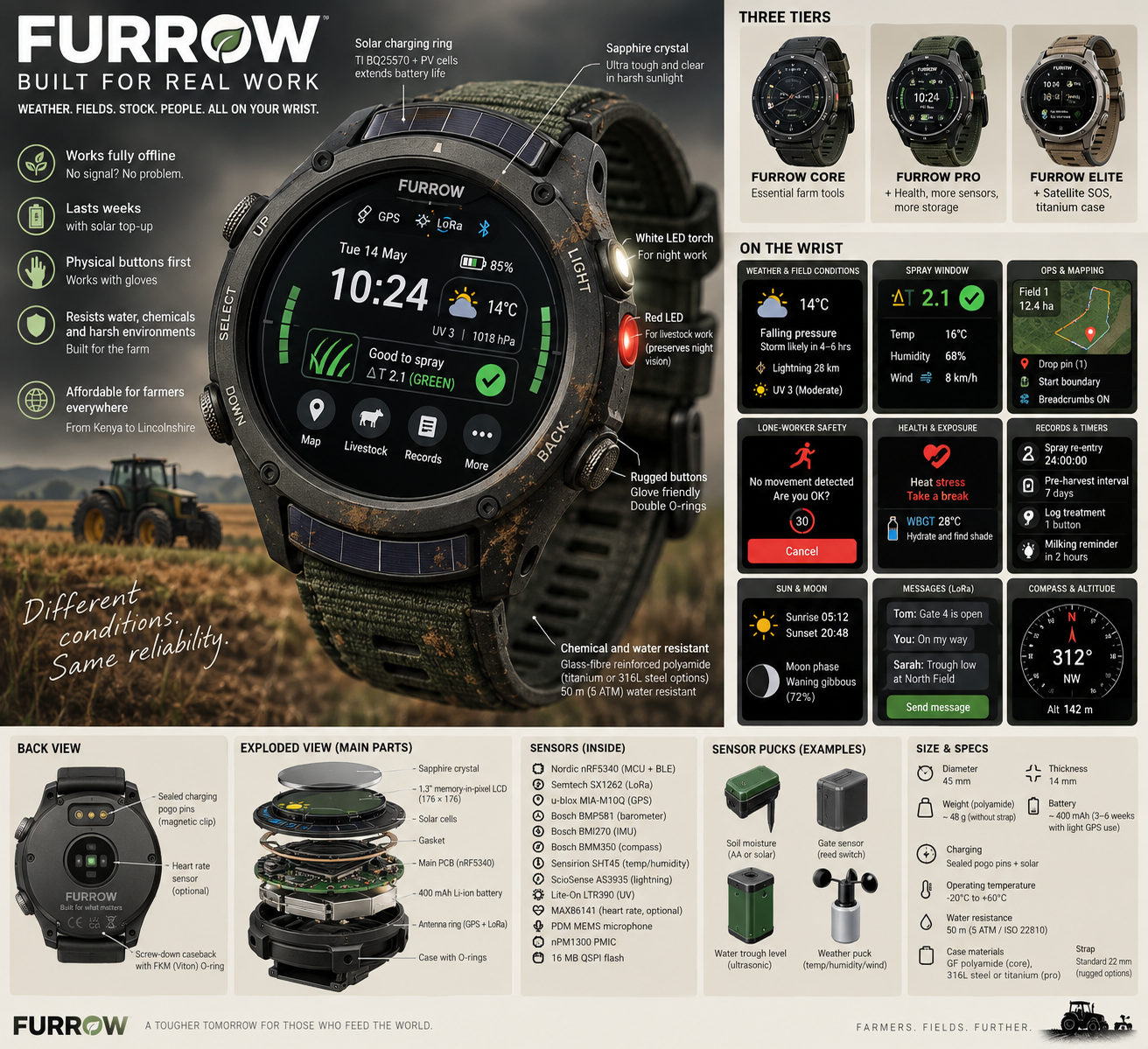
What it actually does
Spray window (the killer feature). Delta T is the difference between dry-bulb and wet-bulb temperature, and it predicts whether spray droplets survive the trip to the leaf. The accepted guidance is a range of 2 to 8; between 0–2 or 8–10 conditions are marginal, and you shouldn't spray under 0 or over 10. Above that band droplets evaporate before reaching the target, increasing drift; below it they don't evaporate, risking runoff and promoting fungal disease. The watch shows this as a traffic light, computed live from a field puck's temp/humidity rather than the wrist, because wrist sensors read your body heat. Add wind speed from the puck and you get a genuine go/no-go.
Lone-worker safety. This is the feature that justifies the whole device. UK agriculture has the highest rate of work-related fatalities of any industry, with a fatal injury rate five times higher than construction and 21 times the all-industry average. Vehicles are the leading cause at around 30% of deaths, followed by machinery, crushing incidents, livestock and falls, and the risk is compounded because farmers are often self-employed and working alone in remote areas without swift access to emergency services. The escalation ladder: impact detected → 30s vibrate → 30s loud alarm → broadcast over LoRa mesh to every other watch and base node on the farm with GPS coordinates → (Sat tier) satellite alert to nominated contacts.
The mesh. LoRa gives kilometres of range with no infrastructure. The firmware is compatible with Meshtastic, which is an open-source LoRa mesh networking project for long-range, low-power communication without internet or cellular, supporting ESP32, nRF52, RP2040/RP2350 and Linux platforms, enabling text messaging, location sharing and telemetry over a decentralised mesh. That means your watch talks to a huge existing ecosystem for free, and any cheap node extends your farm's coverage.
Field pucks. Same radio core, $12–18 BOM each, in an IP68 box: soil moisture, trough level, gate state, frost, grain bin temperature, weather station. The watch is the display for the whole farm.
Everything else. GPS field-area measurement by walking the boundary; one-button pin dropping with voice notes; breadcrumb return; storm warning from barometric trend; UV index; heat-stress alerts; hand-arm vibration exposure logging (relevant to HSE limits for chainsaws and strimmers); noise dosimetry; spray re-entry and pre-harvest interval timers; livestock treatment logging; growing degree days; sunrise/sunset/moon; white torch LED plus a red LED for night lambing that preserves night vision.
This is not going to be launch for a very long time
But this is all the cost to actually doing this the legitimate way:
I have been contact actual Chinese and German digital watch makers.
So far I have Research this:
Certification — budget this properly or it kills you
This is where hardware startups die. Real 2026 numbers:
FCC with pre-certified modules: $3,000–$10,000, 3–6 weeks
CE under RED: €1,500 to €3,000+ for wireless products at minimum; a full campaign runs much higher Ecocomply
UKCA: The UK RER mirrors the EU RED almost exactly, and testing to ETSI standards at a UKAS/ILAC-accredited lab supports both marks from a single test campaign — so do them together Celectronics
RED cybersecurity (Article 3.3): €5,000 to €15,000 for self-assessment
Cyber Resilience Act: now live. CRA reporting obligations started on 11 September 2026: 24 hours to early warning, 72 hours to notification, with penalties up to €15 million or 2.5% of global turnover
UN38.3 battery shipping certification: ~£1,500
ISO 22810 water resistance testing: ~£500–1,500
A realistic 2026 all-in budget for a typical connected consumer device with a pre-certified radio is €60,000 to €120,000 over a nine-month runway from design freeze to launch. For a one-market UK/EU launch with modules you might get to £25,000–40,000, but I don't plan on less.
The honest risks
Antenna performance in a steel or titanium case may force you to plastic for the Sat tier, or to a ceramic-window design. Solar harvesting under a dial realistically adds days, not weeks. Fall detection has a false-positive problem that needs real field data to tune — a tractor over rough ground looks a lot like an impact. And satellite coverage should be verified for your actual target countries before you commit to that tier.
I can go deeper on any single piece — the firmware power budget with actual current calculations, the puck hardware, a proper costed BOM spreadsheet, or a schematic block diagram. Or I can put this whole spec in a doc you can keep and edit as it develops.
This is from a professional Digital Horologist