Skip to content

Free worldwide delivery over £75 ex VAT — coming soon! · Not sure a part fits your build? Ask on the forums or email [email protected]

The Balance Wheel

Long-Term Digital Watch Development - Beta 0.0.1v - Presented By FarmerKnowsNothing.com - Production and Development by WatchMakingWebsite.com

ricardo
ricardo Admin

Bench Hand

#1 · · edited 1 hour ago

RUGGED SMARTWATCH DEVELOPMENT PROJECT · CONCEPT & PROTOTYPE SPECIFICATION

Built for the people who keep the world growing.

Presented by www.FarmerKnowsNothing.com
Production and development by www.WatchMakingWebsite.com

NOTE: THIS IS NOT PRODUCTION YET THIS IS SOMETHING THAT NEEDS PROPER BACKING AND A PLAN.

1. The idea behind FarmerKnowsNothing

Most smartwatches are designed for everyday convenience, exercise and lifestyle tracking. FarmerKnowsNothing takes an entirely different approach.

This is a watch designed specifically for agriculture, where equipment needs to work reliably in demanding conditions. It must withstand accidental knocks against machinery, exposure to mud, fertiliser and diesel, prolonged outdoor use and unpredictable weather.

A farmer should not have to remove their gloves to operate their watch, search for a mobile signal to use essential features or remember to charge another device every evening.

The FarmerKnowsNothing watch platform is being developed around five fundamental principles: independent offline operation, extended battery life supported by solar charging, dependable physical controls, a sealed and chemically resistant construction, and a pricing structure that makes the technology accessible to farms of different sizes.

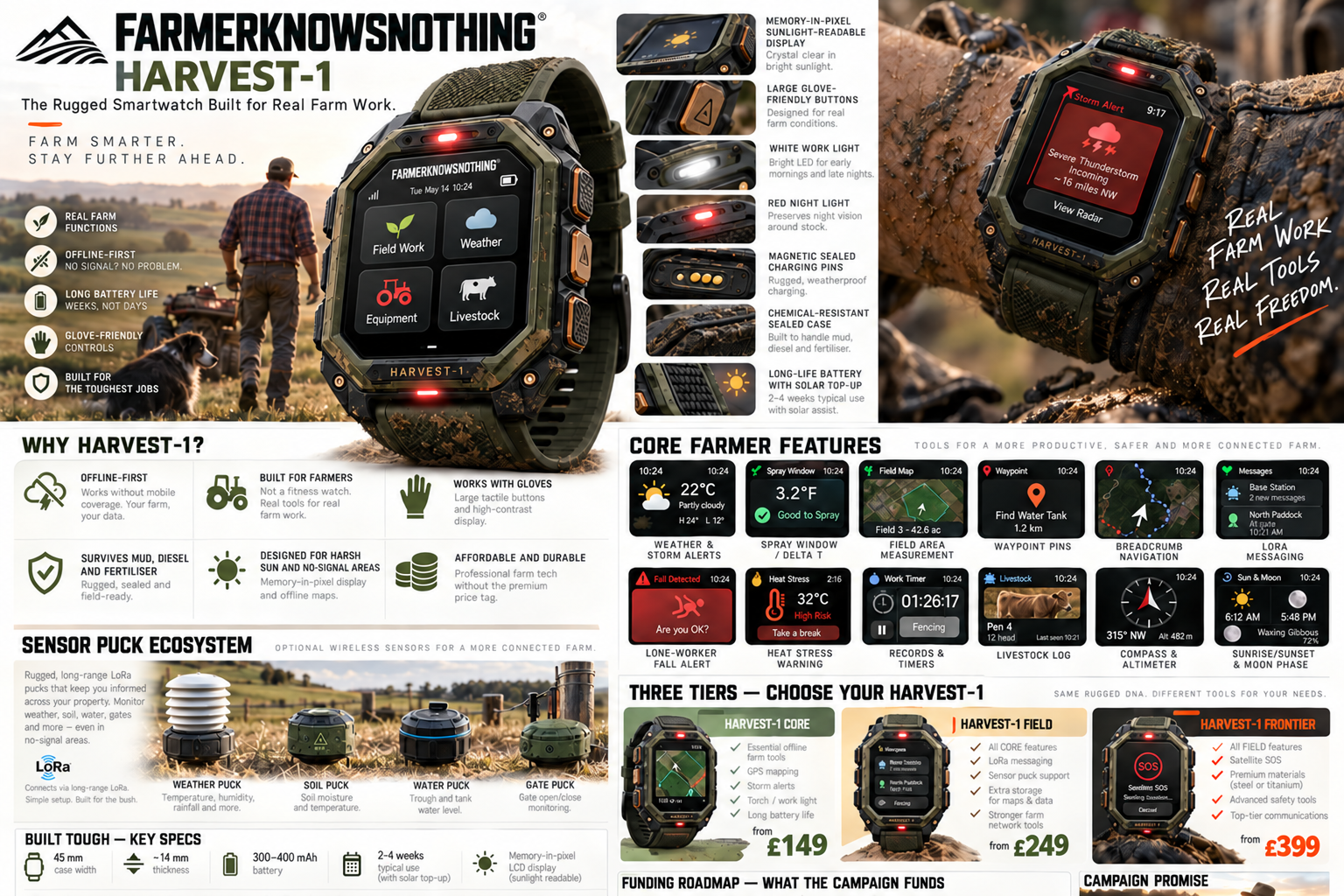
The concept is to develop a family of agricultural watches, from an affordable everyday model to a more advanced professional version with expanded communications and safety capabilities. The same underlying design philosophy applies to every model.

2. Agricultural functions and everyday operation
Weather monitoring and field intelligence

Weather influences almost every decision made on a farm, from spraying and harvesting to livestock management.

FarmerKnowsNothing is designed to provide immediate access to useful environmental information directly from the wrist.

An integrated barometric sensor monitors atmospheric pressure and identifies changes that may indicate approaching storms. A dedicated lightning sensor is proposed to detect electrical storm activity at distances of approximately 40 kilometres, providing an additional warning for workers in exposed fields.

Other environmental capabilities include UV monitoring, frost alerts and the automatic recording of growing degree days to assist with crop development and seasonal planning.

For spraying operations, the watch can receive environmental readings from wireless sensors positioned around the farm. Temperature and relative humidity readings are used to calculate Delta T, while wind measurements provide additional information about spraying conditions.

The information is presented through a straightforward traffic-light display, allowing the operator to recognise favourable, cautionary or unsuitable conditions without navigating complicated menus.

Field mapping and navigation

The watch incorporates multi-constellation satellite positioning to support everyday navigation and field management.

A farmer can walk around a field boundary while the device records the route and calculates the enclosed area in hectares or acres.

Locations requiring attention can be saved as digital markers. A damaged fence, blocked drainage channel, livestock problem or machinery issue can be recorded with a simple button press and an accompanying voice note.

For workers operating in unfamiliar locations or poor visibility, breadcrumb navigation records their route so they can retrace it when necessary.

A digital compass and barometric altimeter provide additional orientation information.

Lone-worker protection

Working alone with heavy machinery or livestock introduces risks that ordinary consumer smartwatches are not specifically designed around.

FarmerKnowsNothing proposes a dedicated safety system using its motion sensors to identify potential falls, sudden impacts and extended periods of inactivity.

When the system detects an event that may require assistance, it begins a staged response. The watch first vibrates to request confirmation that the wearer is safe. If no response is received, an audible alarm is activated before the device attempts to transmit an emergency notification.

Depending on the model and available communications, the alert can be sent through a connected phone, the farm's LoRa network or a satellite-capable communication module.

The system is intended to supplement established farm safety procedures, with detection performance and emergency communications requiring dedicated testing before deployment.

Farm-wide wireless communication

One of the central development goals is to make the watch useful beyond the person wearing it.

Using a Semtech LoRa radio, FarmerKnowsNothing is intended to communicate with wireless devices distributed around agricultural land without depending on mobile reception.

Small sensor units, known as field pucks, can be installed wherever information needs to be collected. These may monitor soil moisture, trough levels, gate positions, frost conditions or grain storage temperatures.

The watches can also exchange short messages between workers over a local radio network. The proposed platform includes compatibility with the open-source Meshtastic ecosystem, allowing suitably configured devices to relay messages and extend coverage.

This approach creates the foundation for a farm communication system that continues to function in areas with limited conventional connectivity.

Health and occupational exposure

The device is also intended to help workers recognise environmental and occupational risks.

Heat-stress alerts use temperature and humidity information, with optional heart-rate monitoring, to encourage appropriate hydration and rest.

An integrated microphone is proposed for monitoring noise exposure around tractors, chainsaws, grain dryers and other machinery.

Motion-sensor data can support the recording of work periods involving vibrating equipment, including strimmers and chainsaws, as part of a hand-arm vibration awareness feature.

These are proposed monitoring aids rather than replacements for calibrated occupational exposure assessments.

Agricultural records and reminders

Farm records are often completed after a long working day. FarmerKnowsNothing aims to make routine recording quicker by capturing information at the point of work.

The planned software includes treatment and medicine records, feeding logs, livestock activity and reminders for milking, lambing and calving.

Timers can also help track spray re-entry periods and pre-harvest intervals.

Records are stored locally and transferred to a companion application when a connection becomes available, allowing information to be organised and exported later.

Additional everyday functions include sunrise and sunset information, moon phases and configurable work reminders.

Practical tools built into the case

The watch incorporates a white LED for general illumination and a separate red LED for work during the night, particularly around livestock.

A piezoelectric buzzer provides audible notifications, while a vibration motor delivers alerts when surrounding machinery makes sound difficult to hear.

The interface is designed around recognisable icons, straightforward menus and multiple languages. Physical buttons remain the primary means of operation, especially when the wearer has wet hands or is using work gloves.
ricardo
ricardo Admin

Bench Hand

#2 ·

3. Prototype electronics and component selection

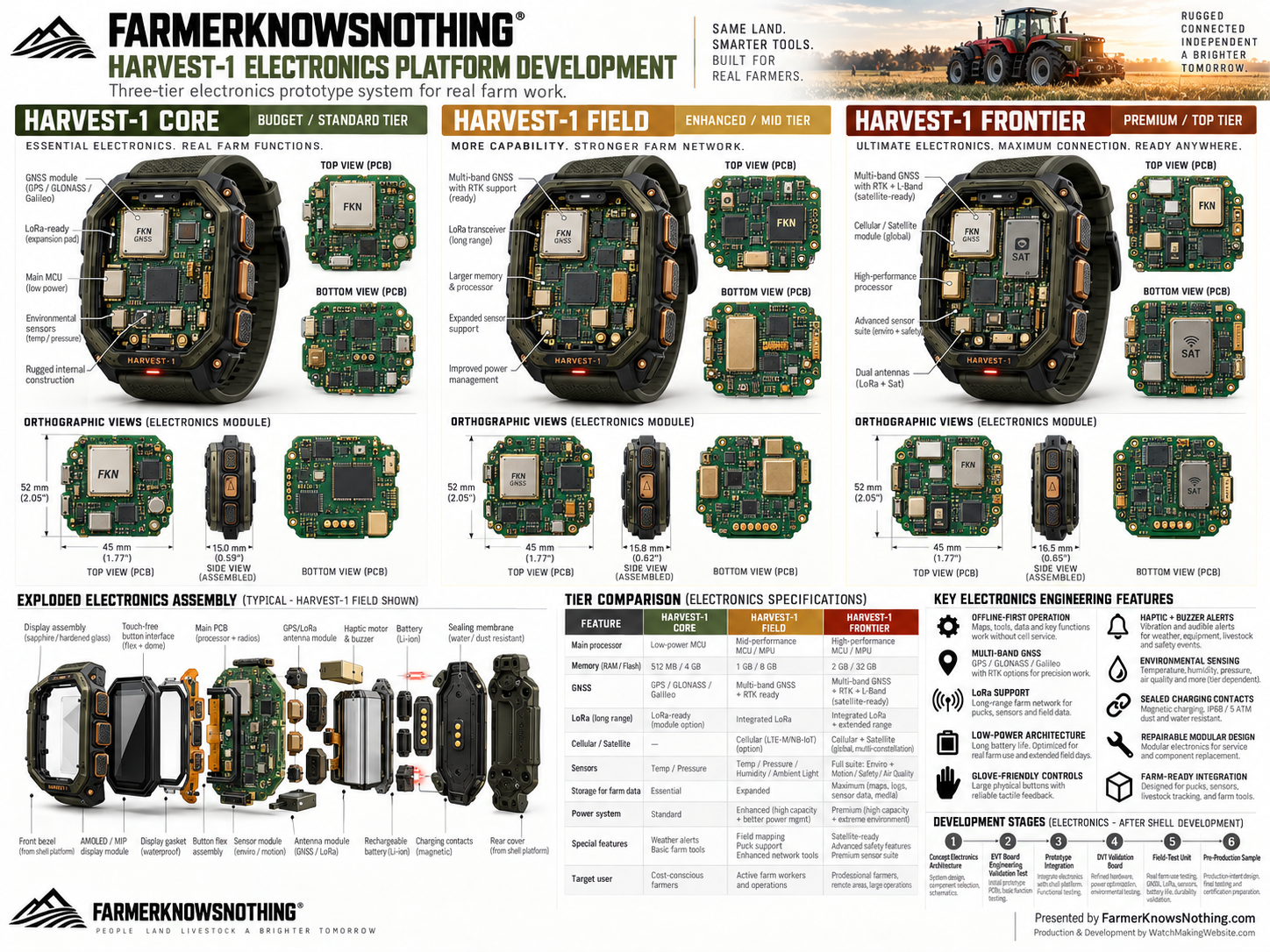
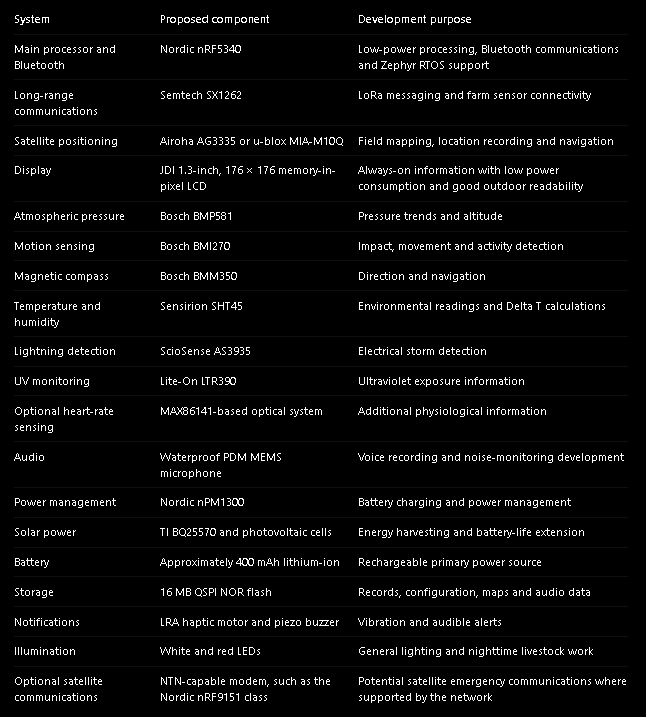
The initial hardware specification brings together low-power processing, environmental sensing, satellite positioning and long-range communications.

The following components form the proposed development platform. They are prototype selections rather than a final production bill of materials.

Image

The power-system design targets approximately three to six weeks between charges under light GPS usage, with solar harvesting providing additional operating time. Actual endurance will depend on radio activity, display configuration, environmental conditions and measured prototype power consumption.

The premium model's satellite functionality remains dependent on compatible networks, service availability and the final communications hardware.

ricardo
ricardo Admin

Bench Hand

#3 ·

4. Wireless field sensor development

The watch will be supported by a modular range of agricultural sensor pucks.

Each puck uses a low-power nRF52 processor and an SX1262 radio inside a sealed enclosure. Depending on its purpose, the unit can be powered by a replaceable AA battery or a small solar system.

A common electronics platform allows different agricultural sensors to be developed without redesigning the entire device.

The proposed range includes soil-moisture probes, ultrasonic water-level sensors, magnetic gate-position sensors and weather units equipped with temperature, humidity and wind-measurement hardware.

These pucks are intended to extend the capabilities of the watch while keeping unnecessary sensors out of the wrist-worn device. Farmers can therefore purchase the equipment relevant to their particular operations.

ricardo
ricardo Admin

Bench Hand

#4 ·

5. Designing the protective housing

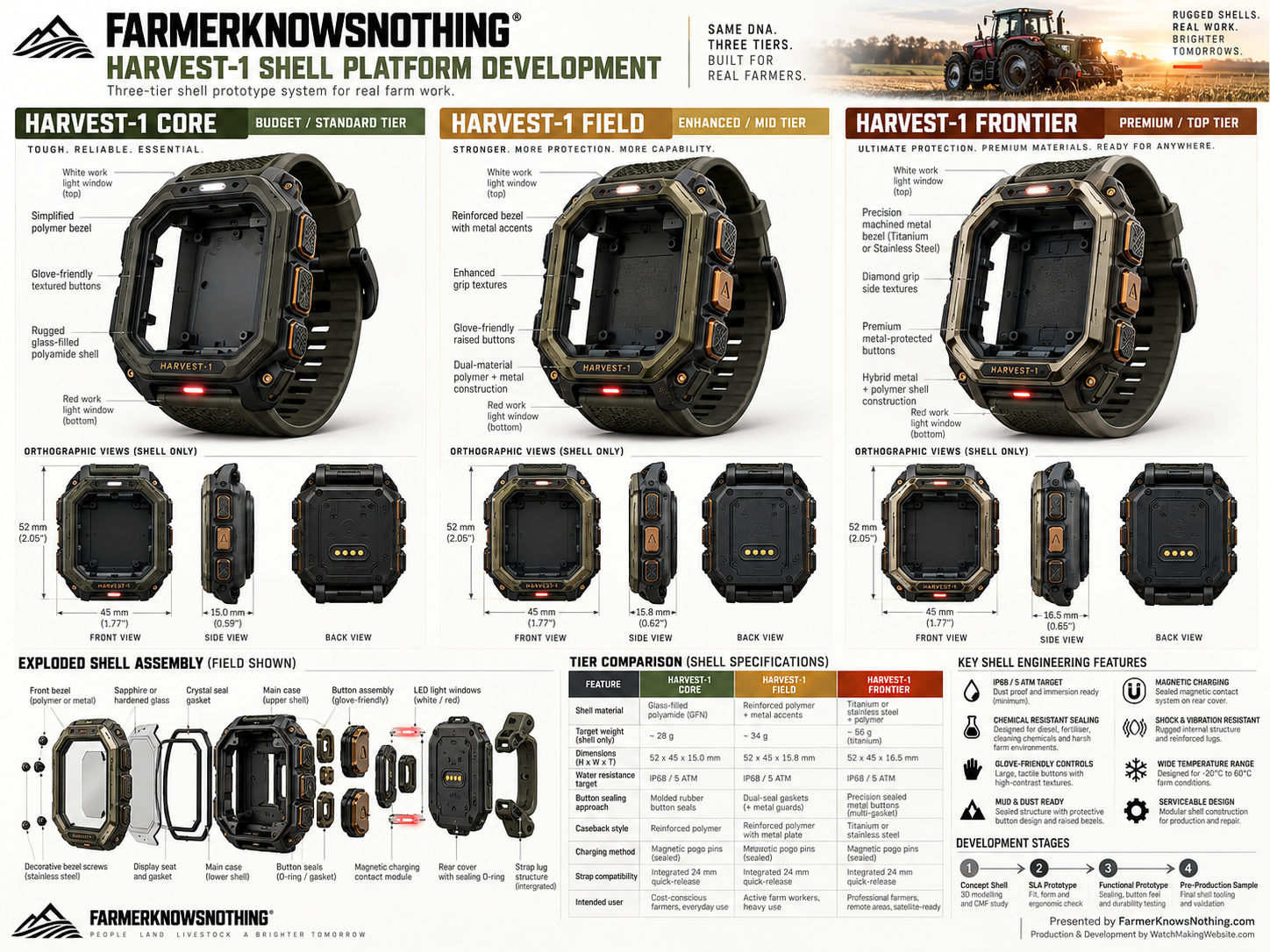
The enclosure is one of the most important elements of the project. The electronics must be protected without making the watch excessively bulky or uncomfortable during long working days.

The development target is 50-metre water resistance, alongside protection against dust, impacts and agricultural contaminants.

The main case material for the entry-level model is glass-fibre-reinforced polyamide. Premium variants may use grade 2 titanium or 316L stainless steel.

A sapphire crystal provides scratch resistance and is supported by an appropriate adhesive and sealing arrangement.

The caseback is designed around a screw-down or six-screw construction, with an FKM sealing ring. FKM is selected for its resistance to a range of oils, fuels and chemicals encountered in agricultural environments.

Each physical button incorporates a double O-ring sealing arrangement and a stainless steel spring.

The microphone and barometric sensor require exposure to the surrounding air. These openings will therefore use waterproof, breathable ePTFE membranes.

Charging takes place through sealed contacts on the rear of the case and a magnetic charging accessory. Removing the conventional USB socket eliminates an additional opening in the enclosure.

The PCB will also receive a conformal coating to provide an extra level of protection against moisture.

The case design will target a 10-bar engineering pressure margin, with the final 50-metre water-resistance rating subject to appropriate testing and validation.

ricardo
ricardo Admin

Bench Hand

#5 · · edited 2 hours ago

6. From concept to working prototype

Stage 01 — Electronics proof of concept
Estimated 1–2 months

Development begins with individual evaluation boards rather than a custom watch PCB. The Nordic nRF5340 development kit is connected to LoRa, GPS and environmental sensor modules to establish the basic operation of the system.

Firmware development uses Zephyr RTOS. At this stage, the objective is to test the individual components, establish communication between them and measure power consumption before committing to a miniature design.

Stage 02 — Custom electronics and PCB
Estimated 2–3 months

Once the core architecture is demonstrated, the components are brought together on a custom four- to six-layer circuit board.

KiCad is used for the PCB design, with manufacturing and assembly undertaken by a supplier such as JLCPCB or PCBWay.

Multiple board revisions are anticipated, particularly for GPS reception, LoRa antenna performance and power-management optimisation.

Stage 03 — Mechanical prototyping

The case is initially produced using SLA resin printing to assess component clearances, button positioning, overall dimensions and wrist comfort.

Subsequent samples can be manufactured in MJF-printed nylon or CNC-machined metal to evaluate more representative materials and finishes.

Stage 04 — Environmental and sealing validation

The assembled prototype moves into pressure testing, condensation assessment and controlled exposure to representative agricultural contaminants.

Proposed tests include diesel, diluted fertiliser and hydrated-lime slurry, alongside inspections of the buttons, caseback, crystal and membrane seals.

Test results will determine which enclosure features require revision before field deployment.

Stage 05 — Agricultural field trials

Ten functional prototypes are planned for evaluation by farmers operating in different climates and farming environments.

The proposed trial period is three months, covering cold, hot, humid and dusty conditions. Feedback will concentrate on reliability, battery life, usability, comfort and the agricultural features that prove useful during everyday work.

Throughout these stages, the companion application will be developed alongside the hardware. Flutter is the proposed framework for Android and iOS, with an offline-first architecture for setting up field sensors, synchronising records and exporting agricultural information.

ricardo
ricardo Admin

Bench Hand

#6 · · edited 1 hour ago

7. Preparing the platform for international markets

FarmerKnowsNothing is intended to serve different agricultural markets, rather than being designed around one country or one type of farm.

The radio system will need region-specific configuration or hardware variants to accommodate the different LoRa frequency allocations used around the world. The initial planning covers the 868 MHz band used in the UK and much of Europe, 915 MHz regional variants and the 923 MHz allocations used in parts of Asia.

Before commercial release, the applicable radio, electrical and battery requirements will need to be established for each intended market.

The development plan includes UKCA and CE conformity requirements, FCC requirements for the United States and UN38.3 testing requirements for lithium battery transport, as applicable.

The final objective is a product family that combines durable hardware, useful agricultural software and an expandable sensor network without making mobile coverage or a subscription essential to the watch's core functions.

The next post is research and development and the finial price of the FarmerKnowsNothing - Harvester.

ricardo
ricardo Admin

Bench Hand

#7 · · edited 4 minutes ago

Image

ricardo
ricardo Admin

Bench Hand

#8 ·

Image

ricardo
ricardo Admin

Bench Hand

#9 · · edited 10 minutes ago

Image

ricardo
ricardo Admin

Bench Hand

#10 ·

RESERVERED POST...

ricardo
ricardo Admin

Bench Hand

#11 ·

RESERVERED POST...

ricardo
ricardo Admin

Bench Hand

#12 ·

RESERVERED POST...

ricardo
ricardo Admin

Bench Hand

#13 ·

RESERVERED POST....

ricardo
ricardo Admin

Bench Hand

#14 ·

RESERVERED POST.....

ricardo
ricardo Admin

Bench Hand

#15 ·

RESERVERED POST......

Sign in or create an account to reply.